Making the Leap to Hybrid-Electric Bizjets – Can It Be Done?
A published paper in a peer-reviewed scientific journal provokes a conversation about the future of hybrid-electric propulsion and large-cabin business jets.
As the aviation industry appears to be poised to enter a new era of electric- powered flight with smaller eVTOL air taxis, what are the possibilities that larger, longer-range, hybrid-electric business aircraft may follow in the near future?
That’s the question Ambar Sarup, a structural design engineer for Piper Aircraft, set out to answer in his recently published scientific paper, “Application of Hybrid-Electric Propulsion to ‘Large-Cabin’ Business Aircraft.”
“I actually started the paper when I was attending the University of Illinois,” said Sarup, who earned a Master of Engineering degree in Aerospace Systems in 2022. “For that project, I investigated the use of hybrid-electric propulsion (HEP) for a Gulfstream GV. My recent research paper builds on that, from a more generic perspective, to create something the entire business aviation industry can use.
“With large cabin business jets being the pinnacle of what we have – best aerodynamics, propulsion, efficiency – they also represent the biggest challenge,” Sarup added. “It surprised me that no one has published any papers on the subject.”
Sarup’s paper, which was published in a peer-reviewed international scientific journal, postulates that on a 3,400 nm flight (New York to London), if 5% of the aircraft’s propulsion energy came from HEP, it would “save” nearly 6,000 pounds of carbon emissions – or about 1,900 pounds of fuel. And if you combine HEP with sustainable fuels, the aircraft’s carbon contrail is even smaller.
“Now, multiply that by thousands of similar-length flights over a year, and the fuel and emissions savings are significant,” he said. “I hope that my paper will drive more people in industry and academia to start to look at the hybrid-electric opportunity.”
A Parallel System
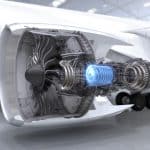
Basically, a hybrid-electric propulsion system consists of a turbine engine, batteries and an electric motor, Sarup explained. And while it seems simple enough, various configurations need to be optimized for optimal long-range aircraft use.
“In my paper, I believe that the parallel system (a combination of turbofan engine and electric motors that assist each other) is the way to go – for a couple of reasons,” Sarup continued. “First off, you are relying on the turbofan engine to do most of the heavy lifting, so the electric components you need are much smaller, and the turbofan’s power-to-weight ratio vastly exceeds anything electric.”
He also said that, with the parallel configuration, you can operate the turbofan engine and electric motors simultaneously or independently, allowing the aircraft’s designer to optimize both propulsion solutions.
“The parallel configuration is also the most technologically-ready solution in the near term,” Sarup added. “I also argue that the parallel configuration requires fewer changes to the basic design of the aircraft. Smaller electrical components, turbofan reliability, and much more efficient batteries can be more easily integrated into current aircraft designs.”
Unfortunately, while the basic components exist to create an HEP solution for smaller, short-range eVTOLs, they’re nowhere close to being ready to power a larger-cabin business aircraft with a range of a few
thousand miles.
“At the end of the day, the aircraft’s weight, aerodynamics and performance requirements aren’t going to change,” Sarup said. “So, whether your propulsion energy comes from fuel or batteries, it takes the same amount of energy to move an aircraft a given distance.”
And when it comes to producing “energy,” even the best of today’s batteries falls woefully short of the energy a gallon of Jet A delivers.
“Jet A runs about 12,000 kilowatt-hours-per-kilogram (wh/kg) – that’s its energy quantity per mass,” explained Dr. Jeff Belt, Ph. D., aircraft battery consultant from Electrochem Technologies LLC, and member of the NBAA Emerging Technologies Committee. “The best battery cells are in the 300 to 400 watt-hours-per-kilogram range.
“So, even if you take into consideration that most heat engines are about 33% efficient, and electric motors are 99% efficient, when you reduce the Jet A’s 12,000 kilowatt-hours-per-kilogram down to 4,000 (33% efficient), you’re still an order of magnitude more ‘efficient’ than the best batteries,” Belt said. “The battery technology is not what you need to impact long-distance flight.”
Battery Capabilities and Alternatives
According to Sarup, the actual “tipping point” for hybrid-electric propulsion to be viable for longer-range business aircraft is a Moore’s-Law-like leap in battery technologies and capabilities. (In case you’re not familiar with it, in 1965, Gordon E. Moore, the co-founder of Intel, stated that, to meet growing processing needs, computer chip ‘speeds’ would have to double every two years.)
But that doesn’t seem likely given how glacially slow battery capabilities are evolving.
“I co-authored a paper a couple of years ago that cited Bloomberg’s estimates of specific energy storage (wh/kg) increases in batteries, and it was only 3% to 5% a year,” Belt said. “That’s part of the problem; it’s a very slow progression.”
While he doesn’t see batteries being a viable power source for business aircraft inflight, Belt did offer up an alternative: “An interesting concept for longer range aircraft is to use battery power for ground operations and taxiing to the runway, then recharge them during flight,” Belt said. “Then use electric power after landing. You would only need small electric motors and batteries that weigh a bit more than the fuel they are replacing or saving.
“That could add some considerable fuel savings across the entire business aircraft fleet,” Belt added. “And it can be done in a very achievable timeframe.”
Belt said support for HEP might come indirectly through ongoing investments in eVTOLs and other AAM aircraft.
“You can look at the automotive industry as a precursor to what may happen in business aviation in the coming years,” explained Belt. “The early Toyota Prius hybrid and its efficiencies have grown into today’s electric vehicles.
“Aerospace could use hybrids for eVTOLs and other niche situations today, and then as electric motor and battery technologies evolve, you can begin to introduce them into longer-range aircraft,” Belt continued. “Ironically, it’s the use of HEP technologies in smaller niche markets that will create an economic need to drive interest and investments.”
Boeing-backed startup Evio is developing a regional airliner with HEP developed by Pratt & Whitney Canada. In France, another startup called Beyond Aero has completed a preliminary design review for a hydrogen-electric business jet that would seat six to eight passengers, supporting a range of 800 nm, with reserves.
Both Sarup and Belt emphasized the importance of certification guidance from regulators.
“What I think we need is a solid certification framework from the FAA and EASA. You really can’t have any real aircraft development without one,” Sarup said. “Once manufacturers have those certification requirements, they can really begin development of the types of hybrid-electric propulsion systems we need.”
“The FAA came out with a ‘harmonization’ document (AC-21.17-4) that, in short, says even though you can get a TSO to install certain ‘electric components’ on an aircraft, there is no current TSO for ‘propulsion batteries,’” said Belt. “So, right now, aircraft manufacturers would have to certify the batteries as part of the aircraft itself, which is at least a recognized pathway. That’s a hurdle, because battery technology is going to change.”
Even with all the various and seemingly monumental hurdles facing the development and certification of hybrid-electric propulsion systems, Sarup is confident that sooner, rather than later, some form of HEP will find a place in long-range business aircraft.
“I think the biggest misconception is that hybrid-electric propulsion is limited to smaller, shorter-range aircraft,” Sarup said. “That’s not true. We can get the range. We can get the speed. And we can get the performance to meet the needs of tomorrow’s long-range business aircraft.”