GE Hybrid-Electric Evaluation Paves Way For Flight Tests
By Guy Norris
GE Aerospace is moving toward flight tests of a megawatt-class hybrid-electric engine system on a modified Saab 340B testbed following the completion of ground tests of the propulsion system at the company’s facility in Peebles, Ohio.
Developed through NASA’s Electrified Powertrain Flight Demonstration (EPFD) project, the propulsion system is based on a GE Aerospace CT7 turboprop fitted with GE-developed motor/generators, power converters, inverters and controllers. The engine is also configured with Dowty propellers, Avio Aero gearboxes and batteries provided by BAE Systems. The nacelle is supplied by Boeing subsidiary Aurora Flight Sciences.
The completion of ground tests marks a key milestone for GE’s EPFD effort, which began with the award of a $179 million NASA contract in September 2021. Further progress came in 2022 when the propulsion system successfully operated in simulated altitude tests at NASA’s Electric Aircraft Testbed facility in Sandusky, Ohio.
Tests at Peebles simulated a variety of operational phases ranging from taxi and takeoff to climb and cruise. “The electric powertrain helped successfully power the propeller and generated power to the battery,” GE says, adding that “flightworthy components that meet higher safety and reliability requirements than typical test hardware were used as part of GE Aerospace’s efforts to mature a commercial-grade hybrid-electric engine system.”
“The ground test is a major turning point in our understanding of hybrid-electric powertrains for aviation and a fundamental building block for the future,” says Arjan Hegeman, vice president for future of flight at GE Aerospace.
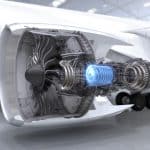
In parallel work, GE also recently tested a modified Passport business jet engine in hybrid-electric mode, marking a key step toward development of a future single-aisle propulsion system under CFM International’s Revolutionary Innovation for Sustainable Engines (RISE) initiative.
These tests marked the culmination of the Turbofan Engine Power Extraction (PEx) program under NASA’s Hybrid Thermally Efficient Core (HyTEC) initiative, a broad-based effort to develop technology for compact, high-power-density cores for integration with larger, lower-pressure fans—thereby enabling higher bypass ratios.
Lessons learned from the HyTEC and PEx efforts are being fed into the RISE initiative, GE’s program with CFM partner Safran that is aimed at development of an all-new centerline engine with 20% better fuel efficiency than today’s CFM Leap-1.